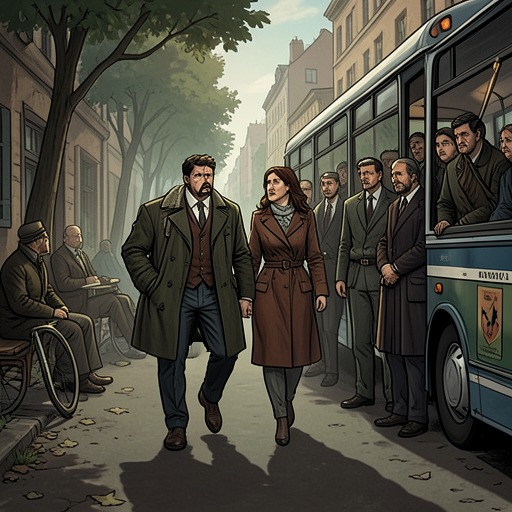
“You’re only as old as you feel.”
The Salt Path“You’re only as old as you feel.” begins as a stranger’s upbeat reassurance to Ray and Moth, who are carrying their packs toward Land’s End without yet feeling confident enough to claim they will make it all the way. The phrase sounds like an uncomplicated compliment about age and energy. On the walk, however, it acquires a sharper edge: the body’s actual fatigue keeps intruding on the reassuring idea that age is merely a matter of feeling.
A stranger’s reassurance
A passerby sees the couple loaded with their packs and asks where they are going. Ray answers, “Land’s End, if we make it.” The qualification matters: their destination is an intention, not a certainty. The stranger responds with encouragement, saying they are only as old as they feel and wishing them luck. In this exchange, the expression works as a friendly lift offered by someone who knows little about the difficulty of their journey. It turns age into a question of attitude, as though confidence and willingness could outweigh the years.
The exchange also gives the phrase a social setting. It is not a maxim Ray or Moth introduces as a considered belief; it is advice from an incidental passerby, prompted by the sight of two heavily laden walkers. Its warmth depends on that limited view. The stranger sees their packs and their undertaking, but the book immediately lets the reader hear the private, less buoyant response that the compliment cannot account for.
Age as appearance and sensation
Ray reflects that she had thought she had aged well: she had reached fifty without going grey or becoming too wrinkled. Her attention is on visible signs of age, and the thought makes the stranger’s remark newly personal. Ray and Moth wonder how old he had taken them to be. When Ray says that, apparently, they are as old as they feel, Moth replies, “Yeah, right.” The phrase has already shifted from encouragement to an object of dry skepticism.
That skepticism is grounded in the difference between looking one age and experiencing the body as another. Moth says he feels eighty some days, is exhausted and hurting everywhere, and cannot tell whether he is half asleep or wide awake. He describes his head as foggy and walking as moving through treacle, calls the undertaking stupid, and says he wants to lie down. The cheerful formula cannot make these sensations disappear. Against Ray’s thought about grey hair and wrinkles, Moth’s account presents age not as a surface but as pain, fatigue, and impaired ease of movement.
The setting intensifies the contrast. At the Valley of Rocks, with their rucksacks on their backs, the couple can no longer brush aside the reality of Moth’s diagnosis and the mental wear of chronic pain. Their silence beside the sea, watching white water break against dark cliffs, follows his outburst rather than resolving it. The expression’s breezy confidence sits beside an illness that has crept up slowly and whose consequences have become difficult to keep at a distance.
The phrase put to the test
Later, the couple weighs whether to wait for the heat to ease. Waiting might leave them on the cliffs after dark, and they are unsure of finding a flat place to stop. In that difficult moment comes the rueful observation that they would have loved the experience when they were thirty. The line does not simply contradict the stranger’s encouragement: it locates the difference between youthful capacity imagined in retrospect and the strain they feel now.
Moth then echoes the earlier expression with the brief question, “Old as you feel?” Ray answers, “Okay.” The callback compresses their earlier exchange into a small, practical negotiation. The maxim no longer sounds like an outside verdict on how old the couple appears. It has become a phrase they can turn over between themselves while deciding whether to continue. After their agreement, they reach the top on the other side of the valley and turn toward the sea cliff. The narrative records both the cost of the climb and the fact that they make it over.
Meaning and limits
The phrase recurs with a changed weight. At first, it offers easy encouragement; then Moth’s sarcasm exposes the distance between a slogan and the lived facts of pain and exhaustion. When the words return between the couple, they are not proof that the physical strain has vanished. They accompany a decision to carry on despite it. The movement from a stranger’s confident reassurance to the couple’s questioning repetition makes the expression less a statement of truth than a test of what encouragement can—and cannot—do.
Its central tension is between age as an impression and age as bodily experience. Ray’s recollection of reaching fifty without obvious signs of ageing concerns appearance, while Moth’s account concerns the immediate limits imposed by illness and chronic pain. The later exchange holds both perspectives without settling them into a single answer. They may feel far older than thirty, yet they still climb out of the valley. In this episode, the saying matters because it is first too simple for their circumstances and then available, in altered form, as language through which they acknowledge those circumstances and proceed.